
A workstation isn’t a desktop PC with a bigger badge. It’s built for sustained performance, expandability, and long-term reliability under heavy, continuous workloads — a larger chassis with room for high-end CPUs, professional GPUs, additional storage, and the cooling to keep all of it stable. Texel Comp supplies and configures radiology workstation computers built on exactly that foundation: Dell Precision, HP Z-Series, and Lenovo ThinkStation towers, specified and set up for diagnostic reading rather than pulled off a shelf.
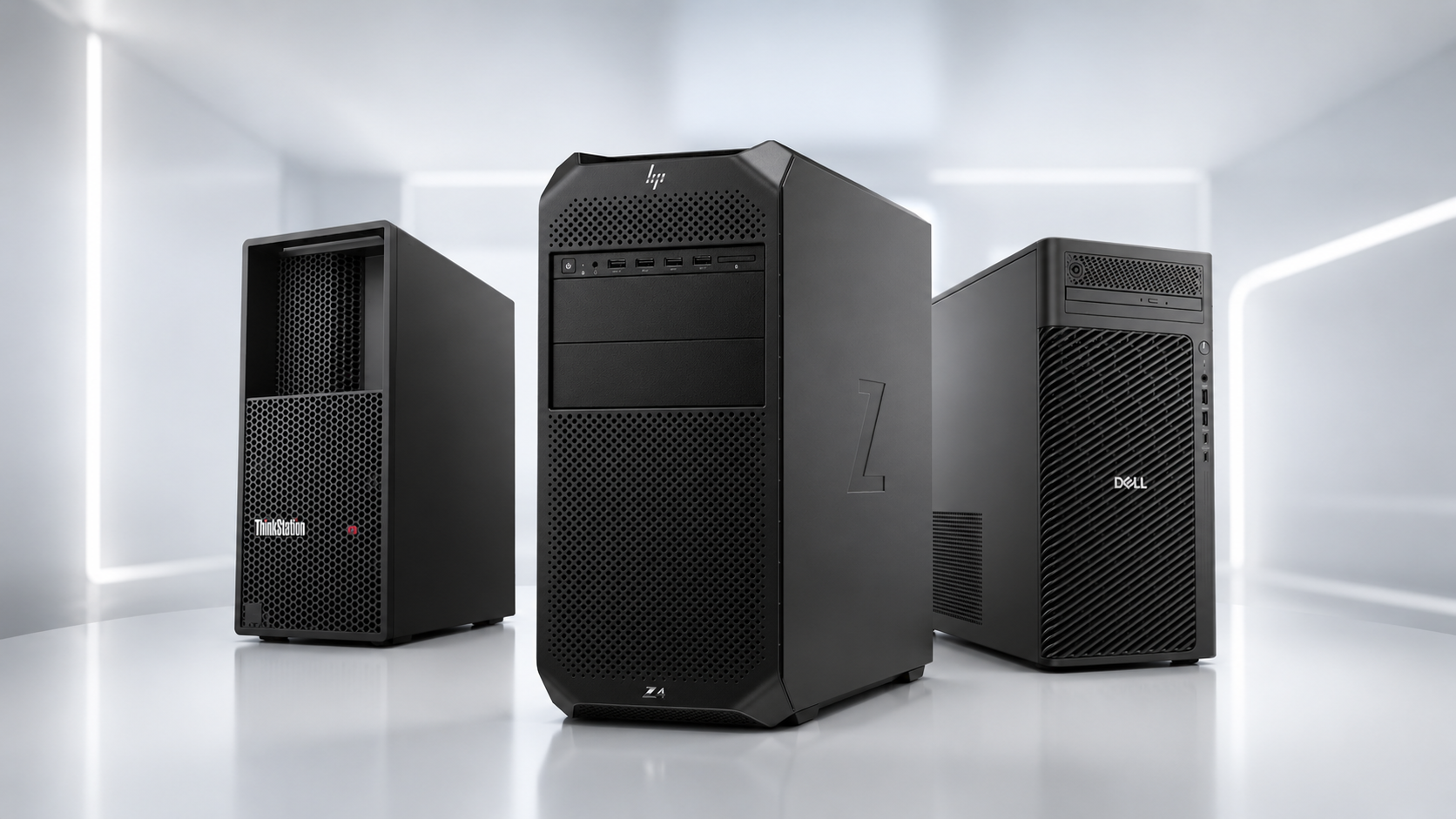
The reason professionals choose a workstation over a standard PC is headroom. The larger chassis leaves space for current-generation CPUs, professional-grade GPUs, additional NVMe storage, and enhanced cooling — so the system stays fast and stable when the work gets heavy. In radiology, “heavy” means loading large CT and MR series, driving multiple diagnostic displays at full resolution, and running PACS and post-processing without lag or thermal throttling.
The GPU is where most radiology workstations succeed or fall short. Driving several high-resolution diagnostic displays without lag takes a professional-grade card — not a gaming GPU — which is why we build around NVIDIA RTX professional graphics and, where the software calls for it, Barco MXRT display controllers. We match the GPU to your exact display count and resolution, then verify the full multi-monitor output in-house before the system ships, so what arrives is already proven against your reading layout.
We supply tower workstations from the brands reading rooms rely on — Dell Precision, HP Z-Series, and Lenovo ThinkStation — and we don’t drop-ship them. Each system is configured in-house before it reaches you: GPU and display drivers set up, multi-monitor output verified, RAM and storage matched to your reading volume, and PACS connectivity tested. New or professionally renewed, single station or a full reading room, the build is matched to the workflow — not to whatever’s in stock.
Our radiology workstation computers are specified around the work, not a generic template:
Request Imaging Support